
Chromosome 24: An Overview
A Conversation About Human Backups, Cloning, AI, and Continuity

Note: I’ve been trying to write about what I’m building with my new company, Chromosome 24. It’s so edgy that it’s difficult to find the right voice, so I’ve been asking AI systems to interview me like I was on a stage or a podcast, something I’m comfortable doing. This interview is a conversation with ChatGPT, a system I’ve been using since its 2022 release. All answers are my own, with minor edits made with Grammarly.
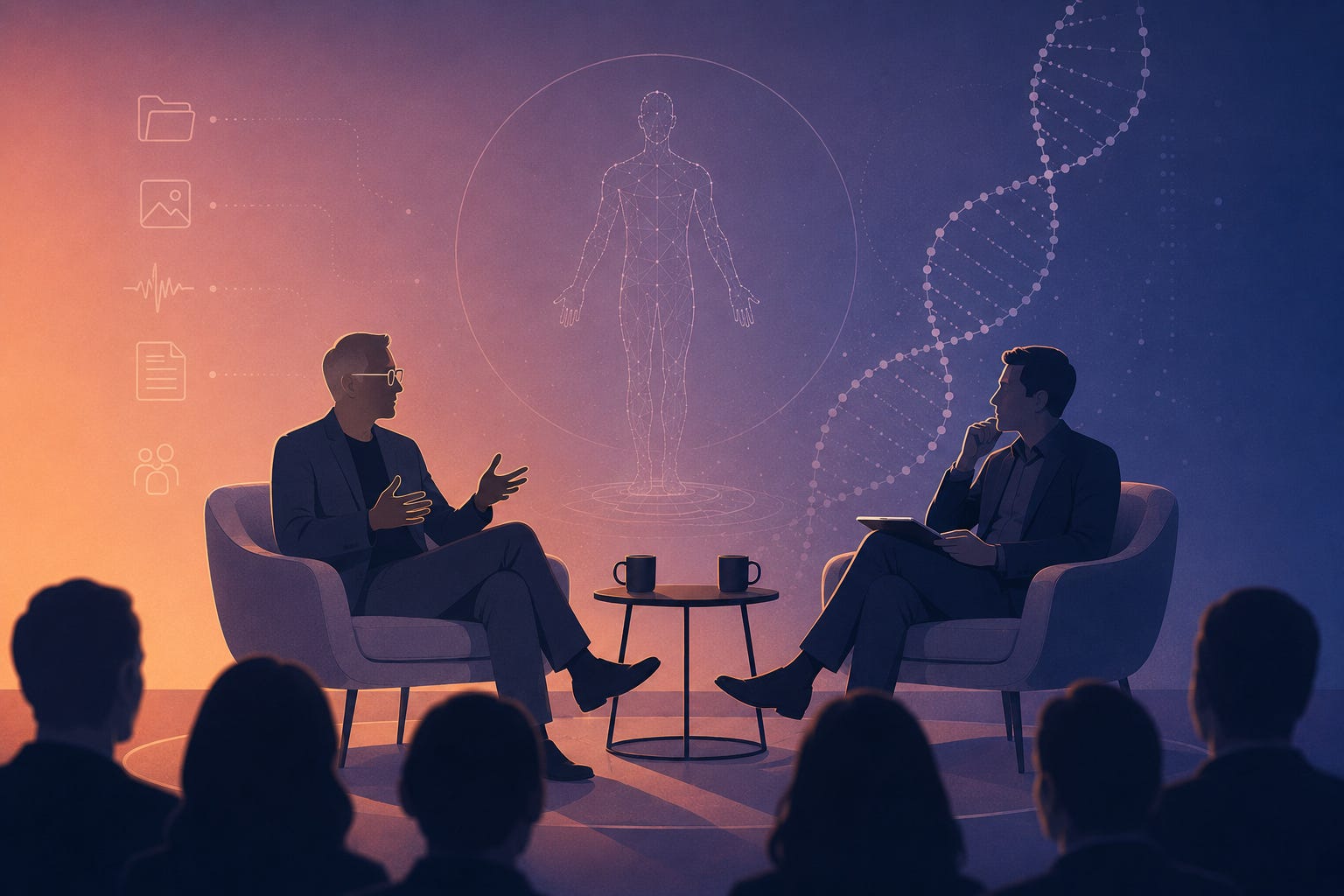
You’ve spent years talking about programming life, synthetic genomes, and biology becoming an engineering discipline. But Chromosome 24 feels more personal and, honestly, more unusual. What is Chromosome 24, in the simplest possible terms, and what made you decide this was something worth building now?
Thanks for asking. I’ve always been interested in the similarities, differences, and intersection of biology and computing, or what I’d describe today as digital biology and digital computing.
Chromosome 24 is a very personal project. It’s rooted in two understandings.
The first is that I’m getting older. I’m now in the last 20-year quarter of my expected lifetime, roughly 80 years. I’m starting to think about my mortality and legacy, putting all my affairs in order, so to speak. If I’m a bit early here, it’s only because I’m a futurist.
The second understanding is that biological death today is a lot like the failure of a digital computing device, our laptops or phones, a quarter century ago. Backups took dedication to set up and do back then, they weren’t automatic, so if a device failed or was lost, pretty much all the software and data were lost, too. I’ve experienced this with my own devices and with the passing of both my parents. Very little information about their lives, in the form of documents, photos, recordings, etc., was passed down to me.
With these understandings, and seeing how automatic cloud backups of our devices have made cloning and resurrecting our lost or damaged digital devices, it is prompting me to explore how human lives can one day be comprehensively backed up and restored.
When you say “backing up a human life,” what exactly do you think should be preserved? What are the components of a meaningful human backup?
I’m still figuring this part out. My reflexive response is to say that everything should be preserved! But this is not reasonable at the moment.
In practice, it’s accounting for, collecting, and archiving as much digital information about a person as we can, and keeping it updated in real time. This isn’t an easy job at the moment. We have files on various cloud systems, on local devices, and in different organizations, such as health providers.
If you’re like me, there are still a lot of paper files, too, currently undigitized. I also have a few hundred gigabytes of raw DNA sequence files from having my genome sequenced a decade ago.
I’m doing my best to collect this information in one place and exploring what AI-based tools can be used to synthesize it and make it more useful.
I’m also adding very important data that cannot yet be fully digitized: my living cells. I’m working to have biopsies stored cryogenically in various biobanks, ensuring that my viable, functional genetic program is archived and available for future use.
What capabilities are you betting on emerging over the next 20, 50, or 100 years that make this preservation effort worthwhile now?
I think future generations will be much more organized about collecting and synthesizing digital data, including genomic information, from birth, if not conception! And they’ll store the cord blood at birth for every child, so biological backups will be automatic.
I’m right on the cusp of this transition. As my life has become increasingly digital, more and more records have been generated and stored. My laptop has about 400GB of data. My Google Drive has 700GB. Our Apple family account is a whopping 3.4TB and growing fast. But this is just the start. I expect to 10X this amount over the next 5 or 10 years. And my kids will likely collect petabytes of data over their lifetime.
But let me be a bit more practical. I’m betting that preserving my information and my biology opens the door to something that was simply impossible to consider until about 30 years ago: being cloned.
With Chromosome 24, then, I’m laying the foundation, biologically, legally, financially, to be cloned in the future I foresee, one where cloning is as normal and accepted as IVF is today.
The information I can preserve today will comprise Chapter 1 of what could be a long genetic story.
If a clone of you existed 100 years from now, why do you see that as continuity rather than simply reproduction? Why is that future individual meaningfully connected to you, beyond just sharing DNA?
Well, for one thing, that future individual would be my brother. My identical twin brother. We will never meet, but we’ll always be connected. They’ll also be connected to any of my relatives who are around when they’re born; he won’t be alone.
I completely understand that my twin would not be me, any more than one identical twin is the same person as the other. Each person is unique, not a reproduction.
And, unlike conventional monozygotic twins, I will be able to gift them a lifetime of experience, ideally in a format that is accessible and useful, managed and presented with AI tools, no doubt. Plus, significant financial resources and other support services — things I didn’t have when I was born.
Importantly, my clone will have a different mother, a surrogate, but one I expect to employ for life. They’ll have different mitochondria, which are maternally derived, and no biological father. Moreover, he will be born in a different societal and technological age, one that, given the rate of change we’re experiencing, will be significantly different than today in 2026.
I don’t have any expectations about their life, other than I’d like for them to have a fulfilling life and contribute to the story of our shared genetic program.
Why do this personally? Why not simply have children, write books, leave recordings, and let future generations remember you the normal way? What feels insufficient about the traditional human approach to continuity?
You’ve asked perhaps the most significant question, and yes, others have asked me about this, too.
My answer is that it is my nature to explore this sort of thing. I am a biologist and a futurist, and my sandbox is the space between real, practical science and the visions of science fiction.
Clones have long had a place in science fiction stories. My personal favorite is Frank Herbert’s Duncan Idaho character from his Dune books; a clone, yes, but one whose memories are cloned as well, extending his consciousness and experience over many lifetimes. Fiction became science when Dolly the sheep was cloned in 1996.
I have two other children that I’m doing my best to provide for, in life and after I’ve passed. Chromosome 24 won’t affect their inheritance; the accounts are separate. The services the company is standing up will also extend to them.
I have written a book, and there are plenty of recordings of me out there. But these materials are scattered all over the place. By making an effort to collect and digitize more of my life history, my family and others will have access to a better archive.
I’ve done some things in my life and career. But creating a twin brother and gifting them a solid foundation and a life-proven genome? Learning how to do this for my wife, children, extended family, friends, and anyone else who is interested? This seems significant, and I’m drawn to big ideas.
If someone were trying to understand the deeper purpose of Chromosome 24, would you say the real goal is preserving information across generations? Biological information, digital information, cultural information, financial information, even relational information? Is Chromosome 24 ultimately an information architecture project disguised as a biotech company?
To start off, Chromosome 24 is about estate planning. Part of this is collecting and archiving information. But the deeper purpose is how to make that information actionable and use it to evolve, to become better.
This is why I call the company Chromosome 24.
I’m already looking ahead to a future where we start to “restore” the people who are backed up. As you’re probably aware, humans have 23 natural chromosomes.
When we clone a person, we don’t alter the natural genome. We just reuse it.
Eventually, we may want to make changes to our genetic program. Here’s where chromosome 24 comes in. It would be a synthetic chromosome, one that we custom-build and add when we create the cloned embryo, to make repairs or enhancements that complement the natural genome.
In software terms, it’s a patch to correct a deficiency or an optional upgrade.
By putting all this extra code on its own designer chromosome, we avoid making edits in the natural DNA.
Where does AI fit into all of this? Is AI primarily an organizational tool for managing overwhelming amounts of personal data? Or do you think AI eventually becomes something closer to a cognitive bridge between generations?
I think this question is a great way to close.
As powerful as AI is, it’s still in its infancy. It’s only going to become more powerful and play an even greater role in our lives. I expect that, one day, we’ll all have our own personal AIs.
Right now, I am using AI tools to help me build my company and to collect and process information about me.
In other facets of my work, I see the intersection of AI and digital biology as an emerging superpower, capable of ingesting and using data in superhuman ways.
Looking forward, I see Chromosome 24 transitioning into an AI-powered, non-profit, multi-family office: a company dedicated to supporting the children and families it’s brought into the world. Done well, it could use this experience to support any family or child who could benefit from its experience.
AI already has PhD-level or greater capabilities in physics, math, and biology. What I like to imagine is that future AI systems will be the best friend, mentor, or parent one could ever want, systems that know us intimately and have watched over us since the beginning.
We’d each have an empowered guardian angel and never be alone or lost. And it could persist even after we pass, becoming the connective tissue between generations.
How cool would that be?
Andrew Hessel is the founder and CEO of Chromosome 24 LLC. He is co-author of The Genesis Machine: Our Quest to Rewrite Life in the Age of Synthetic Biology and chair of the Genome Project-write. Chromosome 24 is at chromosome24.com.